"It is no small crime against humanity to seize the firesides and the property of a whole community, without an equivalent and against their will; and then to drive them, beggared and outraged, into a wild and inhospitable wilderness". (L.H.Morgan, The League of the Iroquois, 1851)
Everywhere around the globe, every day, excavators and bulldozers tear down houses, annihilating the lifestyles associated with them. Massive slum clearance, urban displacement and planetary gentrification sweep the planet; foreclosures, rent spikes, privatization of public housing, securitization of semi-public facilities, touristification, new infrastructures, periodically force countless amounts of people to leave their dwellings.
All cities today suffer the same Haussmanian policies of evisceration, demolitions and mass displacement escalated by totalitarian states such as Mussolini’s Italy, later championed by ominous post-war figures such as Robert Moses. In the last decade, destructive urban policies elaborated in Europe and the United States moved swiftly towards Latin America, Africa and Asia, imposing in the entire world the opening of boulevards, the erection of infrastructures or high-rise buildings, the eviction of working-class residents from the city center, and their relocation in peripheral areas, if not in the countryside.
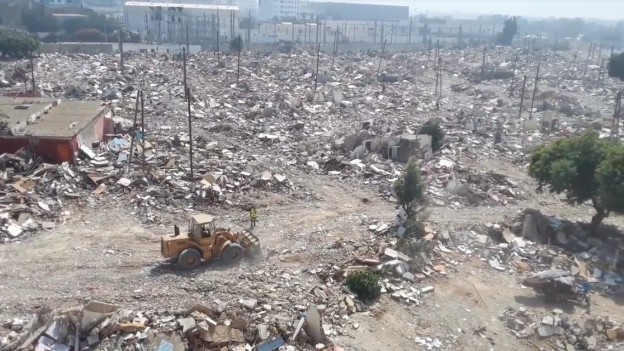
Eviction in Casablanca, Morocco, 2018. Image: Stefano Portelli. See this article
These enormous spatial transformations have an impact not only on individual lives, or on communities; they also influence, though in ways we still only envisage, the basic aspects of human life: culture, society, politics, religion. Our world is changing also due to massive forced mobility, through international borders but also inside them.
Forced mobility is the other face of forced immobility: together, they represent the constant violation of the right to spatial self-determination, or, as Irene Sabaté put it, to residential sovereignty. Each person may need to move or to stay, according to the resources that are available, to the changes of climate, to the form of the territories, and to many other factors. Instead of dividing people into nomads and settlers, migrants and natives, tourists and travelers, let us imagine a world without borders: movement and stillness are part of everybody's everyday life.
Each productive order, however, requires a specific spacial form. Nation states require a structured and legible distribution of the population, often imposed with violence on people who are organized in different spatial configurations. States may impose circulation or sheltering-in-place, prohibit to cross limits or to reside in a specific place; they may force to stand still people that want to move, as happens in prisons, at the borders, with checkpoints or "red-zones"; or force to move people that want to stay put, such as in evictions and forced displacement. Permanence and control over movements are the criteria through which all bureaucracies identify their citizens; those who do not obey may suffer contempt, marginalization, or violence.
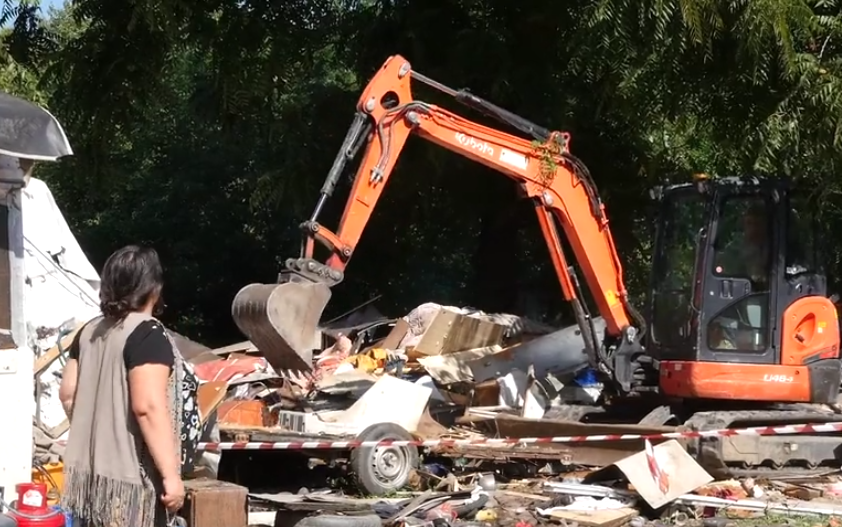
Demolition of a Roma camp in Turin, 2015. Screenshot from the movie "La versione di Jean"
Forced mobility is the other face of forced immobility: together, they represent the violation of the right to self-determination of movement and stillness. States force people to stay put when they need to move – blocking them at the frontiers, enclosing them in prisons and detention centers, denying travel documents or imposing selective “red zones” on public spaces. States, though, also force to move people that would need to stay put. Entire communities are removed, people are pushed to leave their villages or neighborhoods, or chased out from their homes, as bulldozers and caterpillars tear down buildings, houses, facilities, worship sites. The areas that are cleared are enclosed and reorganized according to new criteria, based on the needs of people different than those that lived there.
Forced displacement often hits communities that have already been affected from displacement. So-called “slum residents” that fled to the city after land grabbing, or dispossession of their rural areas, may see the interstitial zones they came to inhabit threatened of new evictions, if the governments need them for new infrastructures, or to attract wealthier people. As the urban population of the planet grows, discrimination has become largely spatial: it is not only access to resources that guarantees status, but the possibility of choosing between staying and moving. Some people are allowed to choose, other people are not.
Even when there are reasonable motives for forced displacement, as happens with so-called “natural” catastrophes, relocation is inevitably oriented by private profit, territorial control, or political advantage of a few. In February 2024 the Moroccan magazine Tel Quel opened the cover page with the title The Bulldozer State(L’État bulldozer): thousands of houses had been demolished to erect hotels and tourist facilities, overlapping with the destruction caused by the 20230 earthquake. Smaller events of this kind happen every day in the cities we inhabit.
A line of continuity connects big and small episodes of displacement, from the constant evictions of people who cannot pay their rents or mortgages, to the evictions of occupied buildings and squats, to the demolition of so-called “slums” or “shanty towns”, to the big expulsions caused by land-grabbing, or the demolitions of entire neighborhoods. Events like the suicide of an evictee in Barcelona, after fifteen years of forced mobility, reproduce at a smaller scale the catastrophe of armed conflict, ethnic cleansing, and genocide: to remove people from their lands, or from their houses, some States are ready to spill their blood.
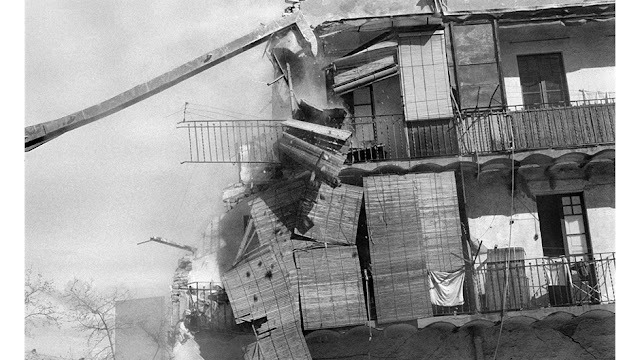
The Barcelona neighborhood of Bon Pastor, razed to the ground between 2007 and 2024. See this article.